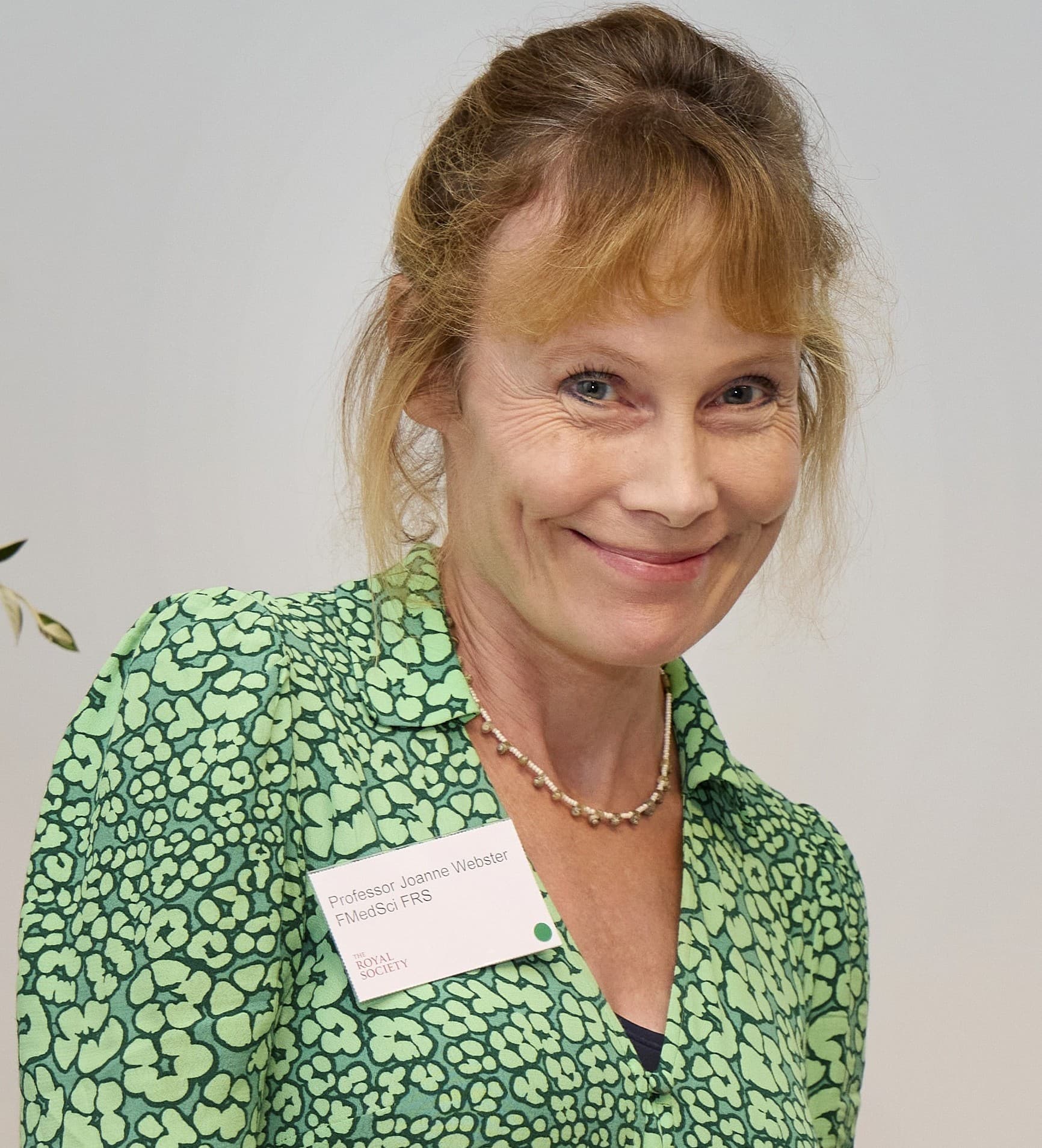
Professor Joanne P. Webster FMedSci FRS
Member
Role
Member
Institution
Royal Veterinary College, Imperial College London and Global Centre for Neglected Tropical Disease Research (GCNTDR)
Committee
External Advisory BoardAbout Professor Joanne P. Webster FMedSci FRS
Professor Webster is an internationally distinguished parasitologist and One-Health scientist whose career bridges fundamental biology, epidemiology, large-scale disease control and global-health policy. She is Chair in Parasitic Diseases at the Royal Veterinary College (RVC), University of London, Visiting Professor of Infectious Diseases at Imperial College London and Director of the Global Centre for Neglected Tropical Disease Research (GCNTDR). The GCNTDR operates as an international platform for equitable research partnerships, capacity strengthening and multidisciplinary work on neglected tropical and zoonotic diseases. Royal Veterinary College, RVC
Professor Webster completed her doctorate at the University of Oxford, where her pioneering work examined zoonotic infections and the capacity of Toxoplasma gondii to alter host behaviour. This helped establish parasite manipulation of host behaviour as an important interface between parasitology, neurobiology, ecology and evolution. Following a period as an NHS Clinical Scientist, she returned to Oxford as a Junior Research Fellow, Lecturer in Infectious Diseases and Royal Society University Research Fellow. She subsequently joined Imperial College London as Professor of Infectious Diseases and helped establish and co-direct the Schistosomiasis Control Initiative. Through this initiative, she contributed to translating epidemiological evidence into mass administration of anthelminthic treatment for millions of children across sub-Saharan Africa—demonstrating an exceptional ability to move research from discovery to population-level implementation.
Her current research is centred on the transmission, evolution and control of parasitic and zoonotic diseases at the human–animal–environment interface. One of her major contributions has been demonstrating that African schistosomiasis cannot always be treated exclusively as a human infection. Her multidisciplinary programmes in Senegal and elsewhere have investigated transmission among people, livestock, wildlife and freshwater snails, including hybridisation between human- and animal-infecting Schistosoma species. This work has major implications for surveillance, praziquantel-based mass treatment and the feasibility of achieving WHO elimination targets where untreated animal reservoirs maintain transmission.
Professor Webster has also contributed to research on praziquantel response and potential anthelmintic resistance, molecular diagnostics, pathogen flow through changing ecosystems and sustainable interventions that integrate human treatment with veterinary public health, water and sanitation, snail control and environmental management.
Her achievements have received major international recognition, including the CA Wright Medal for outstanding contributions to parasitology, the Chalmers Memorial Medal for tropical medicine, the Queen’s Anniversary Medal as part of the Schistosomiasis Control Initiative, and the Royal Society Leeuwenhoek Medal and Lecture for advancing the control of parasitic diseases in humans and animals in Asia and Africa. She was elected Fellow of the Academy of Medical Sciences in 2022 and Fellow of the Royal Society in 2025—two of the United Kingdom’s highest distinctions for biomedical and scientific achievement.
Her distinctive strength is the integration of excellent science with measurable public-health impact. She brings extensive experience in directing international consortia, developing equitable partnerships with endemic-country institutions, converting genomic and epidemiological findings into control policy, evaluating mass-treatment programmes and advising on NTD elimination under real-world conditions. For CTIDR, she provides valuable guidance on One-Health strategy, zoonotic reservoirs, parasite genomics, multidisciplinary programme development, research capacity strengthening, policy engagement and the translation of field evidence into scalable interventions across Nigeria and sub-Saharan Africa.